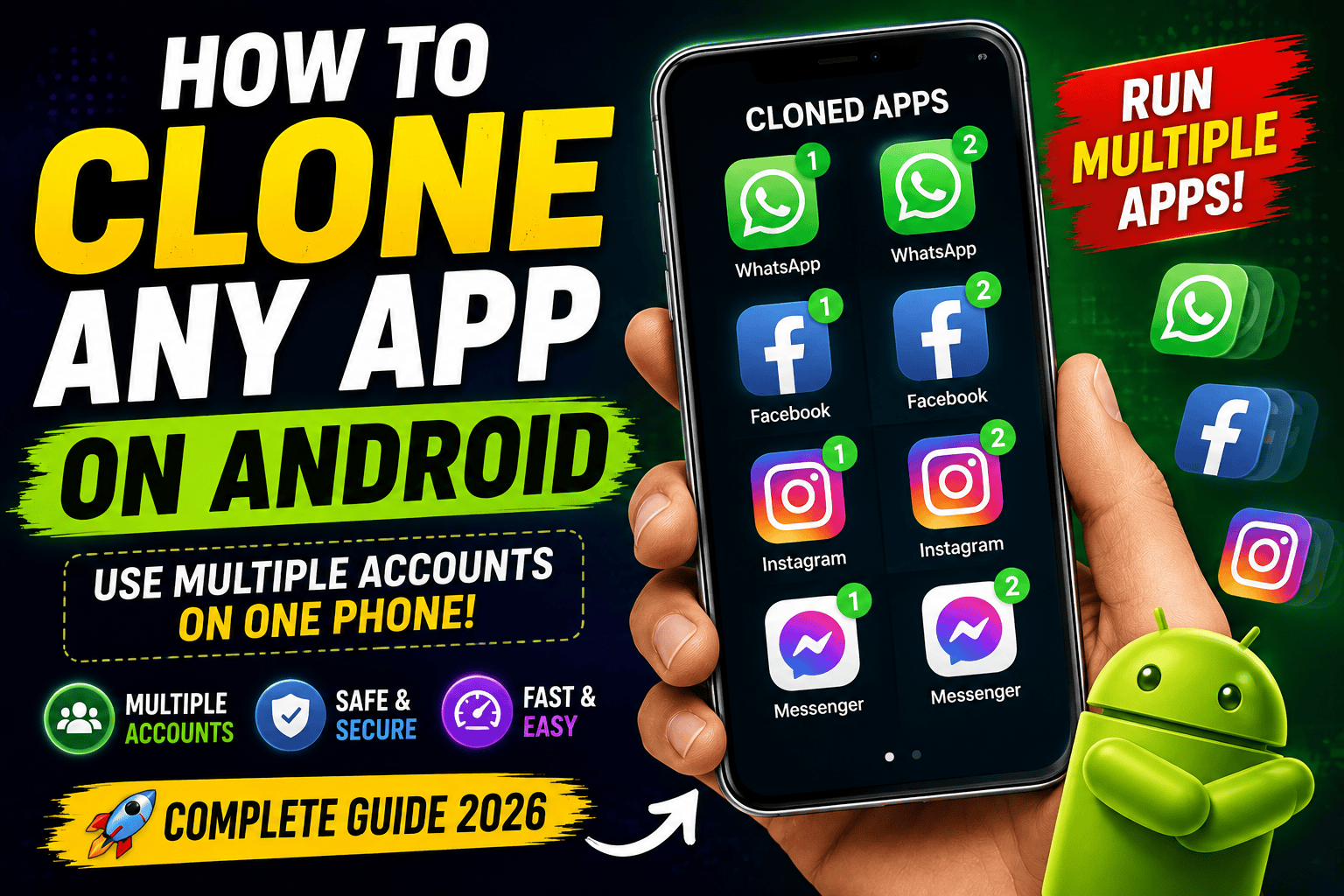
Smartphones have made it much easier to manage almost every part of our daily lives. From messaging and social media to business, gaming, shopping, and education, there is an app for almost everything. But as people start using more apps, another problem becomes common: managing multiple accounts on the same phone.
Maybe you have one WhatsApp account for your family and another for your business. Perhaps you manage several social media profiles for different brands, or you have multiple gaming accounts that you want to keep separate. Constantly logging out of one account and signing into another can quickly become frustrating.
This is where app cloning becomes useful.
Infinite Clone Any App refers to tools that allow Android users to create separate instances of an application on the same smartphone. Each instance can maintain its own account information, settings, and app data. The concept is especially useful for people who regularly work with multiple accounts.
The original article explains that app cloning creates independent environments for cloned applications, allowing users to access multiple accounts without repeatedly switching between them.
In this guide, we’ll look at what Infinite Clone Any App means, how app cloning works, why people use it, its benefits and limitations, security considerations, and the types of users who can benefit from the technology.
What Is Infinite Clone Any App?
Infinite Clone Any App is a concept based on creating multiple copies or instances of an existing Android application.
Normally, when you install an application, Android treats it as one installation. If you log into an account, that account becomes associated with the application. Switching to another account may require logging out first.
A cloning tool changes this experience by creating another environment in which the same application can operate separately.
For example, you could potentially have separate instances of a supported messaging or social media application, with each instance using a different account.
The original source explains that cloned applications can maintain their own data, settings, and account information, making the copies behave like separate installations.
The word “infinite” should not be taken to mean that every Android phone can literally create an unlimited number of clones. The practical number depends on the cloning tool, the application being cloned, available storage, RAM, battery capacity, Android version, and device performance.
Why Do People Clone Android Apps?
The main reason is convenience.
Imagine you use one account for personal communication and another for work. Without cloning, you may have to repeatedly sign out and sign back in whenever you want to switch between them.
That process becomes even more inconvenient when you manage several accounts.
App cloning provides a way to keep separate instances available on one device.
The source article highlights several groups that can benefit from this functionality, including business owners, students, professionals, gamers, social media managers, freelancers, and content creators.
Instead of carrying multiple smartphones, users can potentially manage several accounts from a single device.
How Does App Cloning Work?
App cloning generally works by creating an isolated environment for another instance of an application.
When you select an application to clone, the cloning tool creates a separate space where the application can operate. The original application remains installed normally, while the cloned version operates independently.
This separation allows the two versions to maintain different login information and preferences.
For example:
Original app: Personal account
Cloned app: Business account
Both can exist on the same smartphone.
The exact technical method varies between cloning solutions. Some Android manufacturers provide built-in multi-account or dual-app functionality, while third-party tools may use virtualization or other mechanisms to create additional application environments.
The source notes that performance and compatibility depend on the device’s hardware, Android version, and the application being cloned.
App Cloning vs Switching Accounts
These two approaches may sound similar, but they offer a different experience.
With account switching, you normally remain inside one installation and change the active account.
With app cloning, separate application instances can remain available.
This can be more convenient when you need frequent access to multiple accounts.
For example, a social media manager handling three accounts may find it easier to keep separate instances rather than repeatedly logging in and out.
However, not every application supports multiple instances equally well, so users should test compatibility before relying on cloning for an important account.
Benefits of Infinite Clone Any App
One of the biggest advantages is convenience.
Instead of carrying multiple phones, users can potentially manage several accounts from one smartphone.
Another major benefit is productivity.
If you work with several social media profiles, customer-support accounts, or business communication channels, switching between separate app instances can reduce repetitive login steps.
The source article also points out that app cloning can help separate personal and professional communication, reducing the possibility of mixing different accounts.
Other potential benefits include:
- Multiple accounts on one device
- Easier account management
- Better separation between work and personal activities
- Less need for multiple smartphones
- Faster access to different profiles
- More convenient social media management
- Useful support for multiple gaming profiles
Using App Cloning for WhatsApp and Messaging
Messaging applications are among the most obvious use cases for app cloning.
Someone might want one account for family conversations and another for customers or business contacts.
Instead of constantly switching accounts, separate app instances can make the two communication channels easier to manage.
The same idea can apply to other messaging platforms that support the necessary functionality.
However, users should always check the application’s rules and the available official multi-account options first. If an application already supports multiple accounts, using its built-in functionality may be preferable to installing a third-party cloning tool.
App Cloning for Social Media
Social media managers and content creators often work with multiple accounts.
A person might manage:
- A personal profile
- A business account
- A client account
- A brand page
- A project-specific profile
Managing all of these accounts from one device can become complicated.
Cloning can provide separate environments for supported applications, making it easier to organize different profiles.
The source article specifically identifies social media management as one of the most common uses of app cloning.
For agencies and freelancers, this can be particularly useful because different clients may require separate communication and social media accounts.
App Cloning for Gamers
Mobile gaming is another popular use.
Some players maintain multiple profiles in the same game. They may have a primary account, a secondary account, or different profiles for testing different strategies.
A cloned game can potentially allow another account to run independently from the original installation.
This can save time for players who frequently move between profiles.
However, gamers should be careful about the rules of individual games. Some games prohibit multiple accounts, automated behavior, or certain forms of account manipulation. App cloning does not override those rules.
App Cloning for Business Users
Businesses can benefit from account separation in several ways.
An entrepreneur might have separate accounts for different brands. A customer-support employee might manage different communication channels. A freelancer might need separate accounts for different clients.
Keeping these activities separated can make daily work more organized.
The source article notes that businesses, customer-support teams, freelancers, and digital marketing agencies can use app cloning to manage different communication and social media accounts.
For a small business owner, being able to manage several accounts from one smartphone can also reduce the need for additional devices.
Important Features to Look For
If you are considering an app cloning solution, don’t choose one simply because it promises to create many copies.
There are several factors that matter.
Stability is important. A cloning tool that frequently crashes can become more frustrating than useful.
Compatibility is also essential. Not every application works properly inside a cloned environment.
Security should be one of your highest priorities because cloned apps may contain personal conversations, account credentials, photographs, and other sensitive information.
Ease of use matters too. A complicated interface can make account management unnecessarily difficult.
Some tools may also provide customization features such as changing cloned app names or icons, which can help users identify different instances more easily.
The source article highlights stability, security, usability, customization, and performance optimization as important considerations.
Storage and Performance Problems
App cloning is useful, but it isn’t free from disadvantages.
Each additional application instance requires resources.
If you create many clones, your phone may consume more storage space.
RAM usage can also increase, particularly when several cloned applications are running simultaneously.
On a powerful modern smartphone, the effect may be manageable. On an older or lower-end device, you may notice:
- Slower performance
- More background activity
- Increased storage usage
- Faster battery drain
- Apps closing unexpectedly
The source specifically warns that multiple clones can increase storage requirements and battery consumption, especially on older devices.
This is why creating as many clones as possible isn’t always a good idea.
Only create the instances you actually need.
Banking and Security-Sensitive Apps
Not every application should be cloned.
Banking applications, financial services, password managers, authentication apps, and other security-sensitive software may have protections that prevent them from working correctly inside cloned environments.
The source article specifically notes that some banking and financial applications may restrict cloning because of security measures.
If an important financial application doesn’t work correctly in a clone, don’t try to bypass its security restrictions.
Use the official application and its supported account-management features instead.
Security Risks of Third-Party Cloning Tools
Security is one of the most important things to consider before installing a cloning application.
A cloning tool may have access to application environments, permissions, notifications, files, or other device resources depending on how it works.
Installing an unknown tool from an untrusted website can therefore create privacy and security risks.
The source article recommends obtaining cloning applications from reputable sources and official app stores whenever possible. It also advises users to examine permissions carefully and be cautious about software that requests excessive access.
Before installing anything, check:
- Developer information
- App permissions
- User reviews
- Update history
- Privacy information
- Download source
- Security reputation
If something doesn’t look right, don’t install it.
Protect Accounts Inside Cloned Apps
Creating a clone doesn’t automatically make your accounts secure.
You should still use strong, unique passwords for your accounts.
Two-factor authentication should also be enabled whenever the service supports it.
If your cloned applications contain sensitive information, protecting your phone with a strong screen lock is equally important.
Keep Android and your applications updated because updates can include security fixes and compatibility improvements.
The original article recommends strong passwords, two-factor authentication, regular updates, and careful permission management.
Built-In Android Cloning Features
Before installing a third-party cloning application, check whether your phone already includes a built-in feature for running multiple copies of selected applications.
Some Android manufacturers provide their own solutions for dual apps, app cloning, or multiple accounts.
Built-in tools can be attractive because they are integrated into the device software and may offer better compatibility than third-party alternatives.
The availability and name of these features depend on the phone manufacturer and Android version.
If your device already supports the number of accounts you need, there may be no reason to install an additional cloning application.
Who Should Use App Cloning?
App cloning can be particularly useful for people who regularly manage multiple accounts.
This includes:
Business owners who separate customer and personal communication.
Freelancers who work with several clients.
Social media managers who handle different brands.
Content creators who operate multiple profiles.
Gamers who maintain separate supported accounts.
Professionals who need separate work and personal accounts.
Everyday users who simply want more convenient account management.
For someone who only needs one account, however, cloning may provide little benefit.
Is Infinite App Cloning Really Unlimited?
This is an important question.
Despite the name “Infinite Clone Any App,” real-world cloning isn’t literally unlimited.
Every smartphone has physical limitations.
Storage, RAM, processor performance, battery capacity, Android restrictions, and application compatibility all affect how many cloned apps can run effectively.
The source article also explains that the number of practical clones depends on the application’s capabilities and the device’s available resources.
Therefore, it is better to think of “infinite” as describing the ability to create multiple instances rather than assuming you can create an unlimited number without consequences.
The Future of App Cloning
App cloning is likely to become more integrated into smartphones as users continue to maintain multiple digital identities and accounts.
The source article suggests that future developments may improve resource management, security, compatibility, automation, and account management. It also points out that device manufacturers are increasingly including multi-account functionality directly in Android-based devices.
Cloud integration could also make managing multiple accounts easier across different devices.
Artificial intelligence and automation may eventually help organize accounts and optimize resource usage automatically.
The technology is therefore moving toward a more seamless multi-account experience.
Final Thoughts
Infinite Clone Any App represents a useful approach to one of the most common problems faced by modern smartphone users: managing multiple accounts on one device.
Instead of repeatedly logging out and signing in, app cloning can provide separate instances of supported applications. This can be useful for personal and business accounts, social media management, gaming, freelancing, customer support, and many other situations.
The biggest advantages are convenience, organization, flexibility, and productivity.
At the same time, cloning isn’t something users should approach without considering the downsides. Multiple app instances can consume additional storage, RAM, and battery. Some applications may not work correctly in cloned environments, while security-sensitive services may deliberately restrict this functionality.
Security should always come first.
Use trusted cloning solutions, carefully review permissions, keep your software updated, use strong passwords, and enable two-factor authentication where possible. For banking and other sensitive services, rely on official account-management options rather than trying to bypass security restrictions.
For users who genuinely need multiple accounts, app cloning can be a practical way to get more flexibility from a single Android smartphone.
As Android devices become more powerful and manufacturers continue improving multi-account features, managing several digital identities on one phone is likely to become even easier in the future.
In simple words, app cloning is not about having more phones. It is about making one phone capable of handling the different accounts and responsibilities that are already part of your digital life.